Does a forum help SEO? It can, when it has an active community producing genuinely useful discussions, because every good thread is a fresh page answering a real question in real people's words. An empty or spam-filled forum does the opposite: hundreds of thin pages that dilute your site. The difference comes down to activity, moderation and a few technical basics.
This guide covers when a forum earns search traffic, the technical setup that stops it producing thin pages, how to monetise it, and how to decide whether one is right for your niche site.
Does a forum help SEO? Why forum content can rank
Forums produce a steady supply of long-tail content you would never think to write yourself: specific problems, comparisons, first-hand experiences and follow-up questions. Search engines value that kind of content. Google describes forum-style markup as a way to help it identify "firsthand perspectives" on the web, and uses discussion content in features such as Discussions and forums results (see its discussion forum structured data documentation).
A forum also brings returning visitors, internal links between related threads, and natural mentions of your site elsewhere when members share threads.
When does a forum hurt SEO?
- No community. A forum with a handful of posts creates empty category pages and one-reply threads.
- Spam. Unmoderated forums fill quickly with spam links and junk accounts, which damage trust in the whole domain.
- Thin automatic pages. Member profiles, tag pages, print views and paginated lists can create thousands of near-empty URLs.
- Duplicate URLs. The same thread reachable through several addresses splits signals.
- Private content in sitemaps. Listing pages search engines cannot access wastes crawling and causes errors.
Before launching, ask whether your niche has people who want to talk to each other, not just read. Hobbies, technical topics, local communities and professional niches tend to work; pure transactional niches rarely do.
Forum, comments or Q&A section?
A full forum is not the only way to add community content. Compare the options honestly before committing:
| Option | Best for | SEO upside | Effort |
|---|---|---|---|
| Article comments | Sites with a steady readership but little peer-to-peer discussion | Adds freshness and questions to existing pages | Low, but spam control still needed |
| Q&A section | Niches where people ask specific, answerable questions | Each answered question can rank on its own | Medium: someone must answer |
| Full forum | Niches where members want ongoing conversation with each other | Large volume of long-tail pages and returning visitors | High: moderation, community building, upkeep |
If you are unsure, start with comments or a Q&A area and graduate to a forum when members start talking to each other rather than to you.
Forum SEO: the technical basics
Whatever software you use, check these:
- SEO-friendly forum URLs. Readable addresses such as /threads/choosing-a-camera-strap/ rather than ?t=4821&p=2, with old links redirected if you migrate.
- Automatic titles and meta descriptions built from the thread title and first post, so each page is labelled uniquely.
- Canonical URLs so each thread has one preferred address.
- A forum XML sitemap that lists public threads only, split into several files for large forums.
- Forum structured data for discussions, replies, breadcrumbs and profiles, so search engines understand the page.
- Thin pages kept out of search, especially tag pages with one or two threads.
- Link controls: user-posted links should be qualified (for example with rel="ugc") and new members prevented from posting links until they have a track record.
Our technical SEO checklist covers the site-wide basics that apply to forums too, such as speed, HTTPS and crawl control.
Choosing forum software with SEO built in
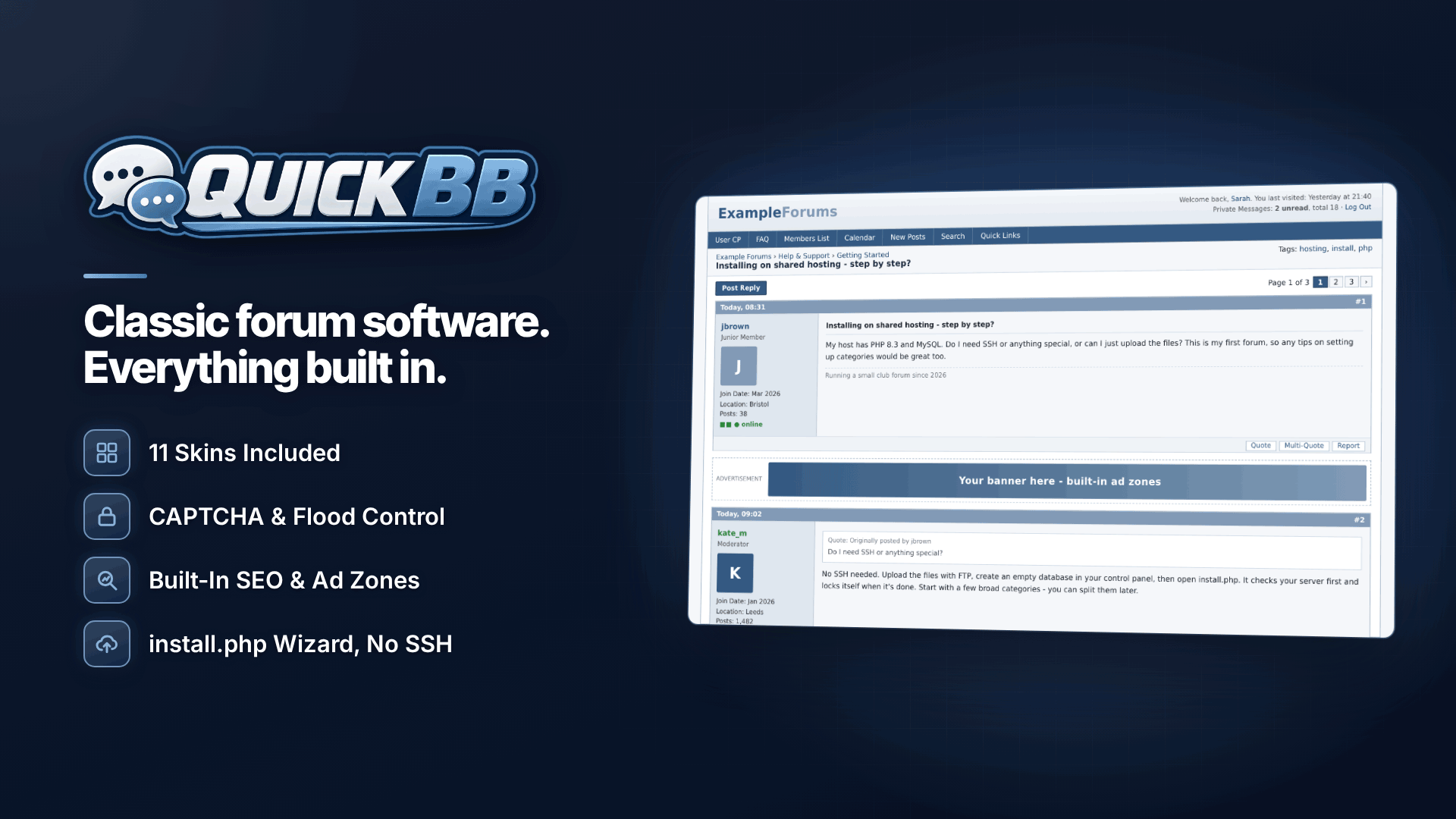
Fixing these by hand on a forum is painful, so it pays to choose software that handles them by default. Quick BB is self-hosted PHP/MySQL forum software in the classic message-board style, and its SEO features map closely to the checklist above:
- Friendly URLs for forums, threads, members and tags, with old-style links redirected.
- Automatic titles and meta descriptions, and canonical URLs.
- XML sitemaps, split for large forums, that exclude private, unapproved and deleted content.
- Structured data for discussions, replies, breadcrumbs and profiles.
- Thread tags and optional hashtags, with thin tag pages kept out of search.
- Numbered pages rather than infinite scroll, which gives crawlers stable, linkable pagination.
Spam control matters just as much for SEO. Quick BB includes a server-generated image CAPTCHA with an accessible alternative, honeypots, registration rate limits, new-member approval, first-post moderation, duplicate and excessive-link detection, banned words and email domains, and it restricts links for new members until they have five approved posts.
Hosting note: it needs PHP 8.2 or newer and MySQL 8.0+ or compatible MariaDB, and runs on ordinary Apache or LiteSpeed shared hosting (Nginx instructions are included). No SSH, command line or root access is needed; installation runs in the browser.
How do you get a new forum going?
Search traffic follows activity, not the other way round. To get past the empty-forum stage:
- Start narrow. Four or five forums, not forty. Empty categories look abandoned.
- Seed real discussions. Post genuine questions and answers yourself and invite people you know in the niche. Do not invent fake members or conversations.
- Link from your main content. Add "discuss this" links from relevant articles to matching threads.
- Answer fast. Early members stay when their first post gets a quick, useful reply.
- Moderate from day one. One spam wave can undo months of work.
Running a community also brings legal duties for user-generated content in the UK and EU; see running a small forum under the Online Safety Act and DSA.
How do you make money from a forum?
Forum traffic is engaged but notoriously reluctant to click ads, so placement matters. Common models are display banners, sponsored sections, affiliate links in resource threads and premium membership tiers. Our comparison of affiliate links vs display ads helps you decide which suits your audience.
The software has built-in advertising: banner uploads (JPEG, PNG, GIF including animated, and WebP), seven zones (header, footer, left and right sidebars, every 10 threads, every 5 posts, and the post redirect page), start and end dates, random, sequential or weighted rotation, and impression, click and CTR statistics. Keep ads relevant and restrained; a forum buried in banners loses members.
How do you measure whether the forum is helping?
Give a new forum six to twelve months before judging it, then look at:
- Organic landing pages in Search Console filtered to the forum path: how many threads get impressions and clicks.
- Indexed vs submitted pages for the forum sitemap, to spot thin or blocked pages.
- Returning members and new threads per week, the leading indicators of future search traffic.
- Revenue per thousand forum pageviews against your articles, so you know what the community is worth.
If threads are not getting indexed after months, the problem is usually thin content or crawl waste, not the forum idea itself.
Forums on adult and affiliate sites
Forums can work well alongside adult or affiliate content sites, giving users a place to compare and discuss rather than just consume. They also need tighter moderation, clear rules and age-appropriate access controls. See our guide to ranking an adult website for the wider SEO context.
Frequently asked questions
Should a forum go on a subdomain or a subfolder?
A subfolder such as /forum/ keeps the forum's content clearly part of your main site, which suits most niche sites. A subdomain can make sense if the forum is a separate product with its own audience.
Should member profiles be indexed?
Usually only profiles with real content. Thousands of empty profiles are thin pages; keep low-value profiles out of search where your software allows.
Can I move an existing forum without losing rankings?
Yes, if old URLs redirect to the new ones. The software includes importers from popular open-source forum software and CSV, with dry runs and ID mapping, and redirects old-style links.
Next steps
Check whether people in your niche already gather on forums or groups elsewhere; if they do, there is room for a well-run one on your site. Compare tools in our webmaster software directory, or look at how Quick BB handles friendly URLs, sitemaps and ad zones out of the box.