
Yes, you can still run a small forum under the Online Safety Act and the DSA. Small forums are not banned or licensed, but if UK users can post, the Online Safety Act requires you to assess the risk of illegal content, take proportionate steps against it, and offer easy reporting and complaints; for small, low-risk services Ofcom expects only the minimum set of measures. If you serve EU users, the DSA adds notice-and-action and statement-of-reasons duties. Good moderation tools make this manageable, but compliance comes from your processes, not your software.
This article sets out which duties typically apply to a small user-to-user service, what Ofcom and the EU expect in practice, and how to map those duties to day-to-day forum moderation. It is general information, not legal advice; take professional advice for decisions about your own service.
Does the Online Safety Act apply to small forums?
The Online Safety Act 2023 covers user-to-user services: any service where users can share content that other users can encounter. A hobby forum, a fan community or a comments-heavy niche site can all qualify if they have links to the UK, for example a significant number of UK users or the UK as a target market. There is no blanket exemption for small or non-commercial forums, although some limited functionality (such as comments only on your own content) can fall outside scope. Our guide to whether the Online Safety Act applies to your website walks through the tests.
The illegal content duties have been in force since March 2025: services had to complete their first illegal content risk assessment by 16 March 2025. Children's access assessments were due by 16 April 2025, and the child safety duties took effect on 25 July 2025 for services likely to be accessed by children. Ofcom can impose fines of up to 10% of qualifying worldwide revenue (or a fixed maximum, if higher) and is actively enforcing.
What does Ofcom expect from a small, low-risk forum?
Ofcom's codes of practice guidance explains that if your risk assessment rates your service negligible or low risk for every kind of priority illegal content, only the minimum number of code measures apply. In practice, for most small forums that means:
- A written illegal content risk assessment, kept up to date and redone before significant changes. See our guide to doing an illegal content risk assessment.
- A named individual accountable for online safety compliance; on a one-person forum, that is you.
- Content moderation that lets you review and swiftly remove illegal content once you are aware of it.
- Easy reporting and complaints for users, with complaints handled appropriately.
- Clear, accessible terms of service explaining how you protect users.
- Records of the measures you have taken.
Medium or high risk for particular harms, for example because the forum allows image sharing between strangers or direct messaging with unknown adults, brings additional measures. If users can share pornographic content, you also need highly effective age assurance; self-declaration does not count.
What are the DSA obligations for forums?
The Digital Services Act applies to intermediary services offered to users in the EU, wherever the provider is based. A forum that stores user posts is a hosting service, and if it makes those posts public it is usually an online platform. The core duties for hosting services include:
- Points of contact for authorities and users, and an EU legal representative if you have no EU establishment.
- Terms and conditions that explain your content rules and moderation clearly, applied diligently, objectively and proportionately.
- Notice and action: an easy electronic way for anyone to report illegal content, with notices handled promptly. See our guide to DSA notice and action.
- Statement of reasons to users whose content you remove or restrict, explaining what you did and why.
- Reporting suspected serious crimes that threaten someone's life or safety to the authorities.
Micro and small enterprises are exempt from most of the additional obligations for online platforms and from the annual transparency reporting duty, unless they are designated as very large platforms. They still have to meet the core hosting duties above.
UK and EU duties side by side
| Duty | UK Online Safety Act | EU DSA |
|---|---|---|
| Assess risk | Illegal content risk assessment; children's access assessment | No formal risk assessment for small services |
| Reporting tool | Easy user reporting and complaints | Notice-and-action mechanism open to anyone |
| Removing content | Swiftly remove illegal content once aware | Act expeditiously on valid notices |
| Telling the user | Complaints procedure | Statement of reasons for each restriction |
| Rules | Clear terms of service | Clear terms and conditions |
| Accountability | Named accountable individual; records | Points of contact; legal representative if outside the EU |
How do you meet these duties with forum moderation tools?
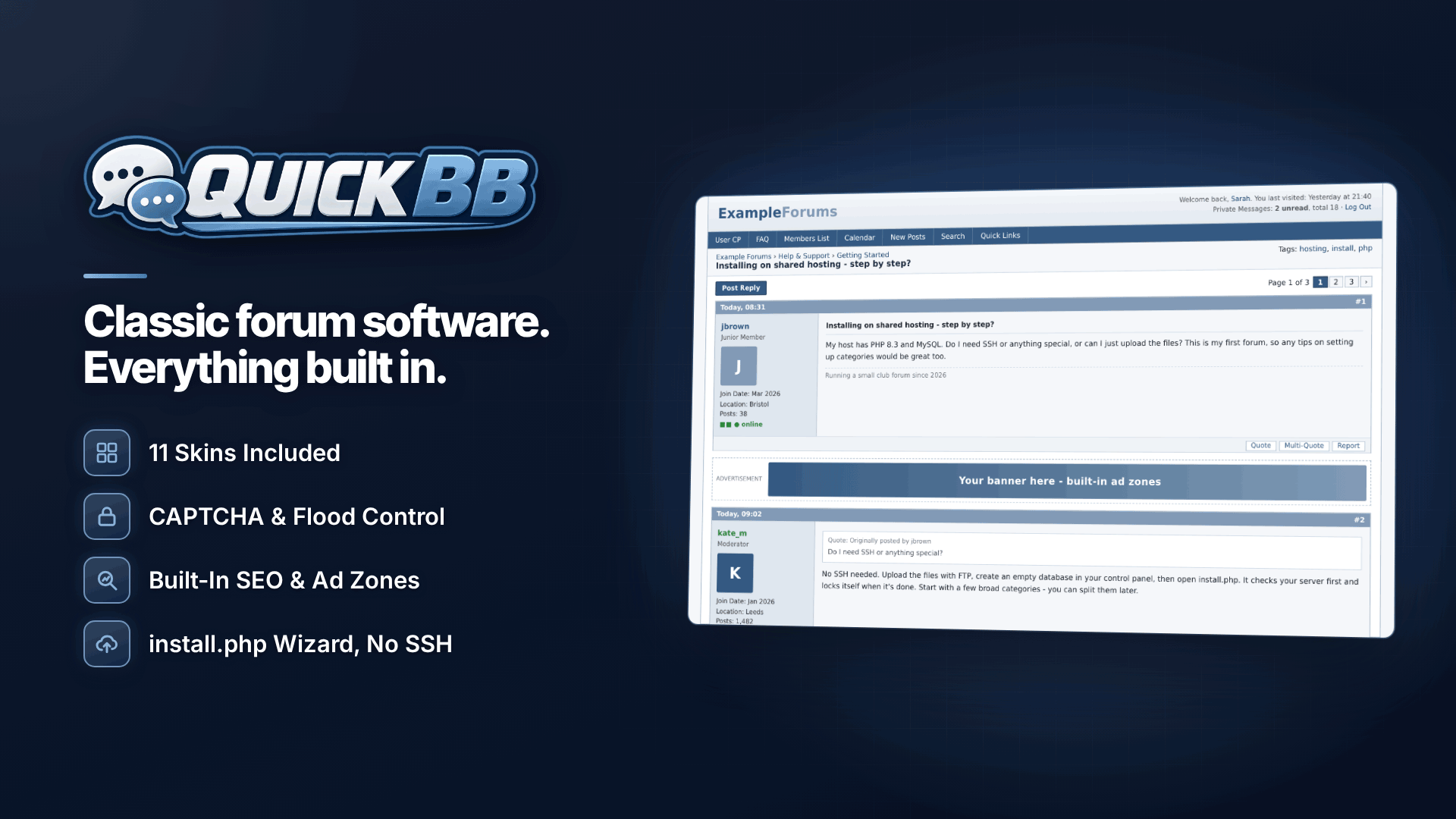
The legal duties translate into a handful of practical systems. Forum software with strong moderation features makes them easier to run day to day. Quick BB is self-hosted forum software whose moderation tools line up well with what regulators ask for, although it does not claim to make a service compliant on its own. Here is how the pieces map:
- Reporting and notice-and-action. A report queue records the reporter, reason, status, notes and action taken, giving you an audit trail of how each report was handled.
- Swift removal. The Moderator CP lets you edit, delete, restore, lock, move, merge and split; actions are logged and permissions are checked server-side.
- Preventing harm before it appears. First-post moderation and new-member approval let you review newcomers before their content goes live.
- Enforcing your terms. Warnings, infractions, suspensions and bans give you graduated responses, all logged.
- Reducing spam and harmful links. Banned words, banned email domains, IP bans, duplicate and excessive-link detection, and links blocked for new members until they have five approved posts.
- Securing staff accounts. TOTP two-factor sign-in is required for administrators by default and optional for moderators.
- Protecting privacy. Moderators have no automatic access to private messages, and members can export their data or have accounts deleted or anonymised.
What software cannot do is decide what is illegal, write your risk assessment, send statements of reasons for you or age-check your users. Those remain your responsibilities. Note that Quick BB does not claim age verification features; if your forum needs them, you will need a separate provider.
Statement of reasons tip: keep a short set of template messages for common removals (spam, illegal content, rule breaches) that state what was removed, which rule or law applied, and how the user can complain. Paste the relevant one when you act and note it in the report record.
Writing clear rules and a moderation policy
Your terms and forum rules are where the UK and EU duties meet. They should say, in plain language, what content is not allowed, how users report problems, what happens when rules are broken, and how to complain about a decision. Pin them, link them from the sign-up page, and apply them consistently. Our guide to building a content moderation policy includes a structure you can adapt.
A realistic moderation routine for a small forum
- Daily: check the report queue and first-post moderation queue; act on anything illegal immediately.
- Weekly: review warnings and bans, look for new spam patterns and update banned words or domains.
- Quarterly: revisit your risk assessment and terms, especially after adding features such as image uploads or private messaging.
- Always: keep records of what you did and why. If Ofcom or an EU regulator asks, records are your evidence.
Frequently asked questions
Do I need to register with Ofcom?
Small services are not required to register simply to operate, but you must meet the duties that apply and keep records you can share if Ofcom asks. Fee-paying obligations apply only to providers above Ofcom's revenue threshold.
Is a private, invite-only forum still covered?
Often yes. The Online Safety Act looks at whether users can encounter each other's content, not whether the forum is public. Private communities may present lower risks, which your risk assessment should reflect.
Can I just close registration to UK users?
Some small sites have chosen to geo-block the UK, but that has its own trade-offs and does not change EU duties. For most well-moderated communities, meeting the minimum measures is more practical.
Next steps
Write or update your risk assessment this week, check that your reporting route and terms are easy to find, and set up a simple log of moderation decisions. For help, see our compliance and verification services directory, and if you are choosing forum software, look at how Quick BB handles report queues, first-post moderation and logged actions.


