
If you are asking how do I check domain availability across multiple extensions, the fastest method is a bulk availability check: enter your brand or keyword once, select every European extension you care about (.de, .fr, .nl, .es, .it, .eu and so on) and check them in one pass, noting the owner and expiry date of any that are taken. Then put the taken names you want on a watchlist so you hear if they drop.
This guide covers which extensions to check, the eligibility rules that catch UK-based webmasters out, how to bulk-check without missing anything, and what to do when a lookup comes back "Unknown".
Which ccTLD should you use for a European site?
Before checking availability, decide whether you need country domains at all. A single .com with language subfolders is often simpler to build authority on; country domains send a strong local signal and can lift trust and click-through in markets like Germany. Our guide to ccTLDs, subdomains or subfolders for European sites sets out the trade-offs. Even if you choose subfolders, it is worth checking and often registering the main country domains defensively, so nobody else builds on your brand.
Can you register every European ccTLD?
Not always. Availability is only half the question; some registries restrict who may hold a domain. Examples worth knowing:
| Extension | Who can register (summary) |
|---|---|
| .eu | Residents and organisations in the EU and EEA, plus EU citizens living anywhere, per EURid |
| .fr | Residents of the EU or an EFTA country; UK residents can't register new .fr names since 1 January 2021 |
| .de | Open to holders outside Germany, but DENIC may require an authorised representative in Germany to receive official documents |
Rules change and every registry has its own, so check the registry or your registrar before you buy. A UK limited company with no EU presence is the classic case of a name that shows as "available" but can't be registered in its own name.
How do I run a bulk domain availability check?
A good routine for a market entry project:
- List your name variants: the brand, the brand plus a niche word, and any local-language version you would actually use.
- Choose your extensions: the countries in your plan, plus .eu and .com as anchors.
- Check them in one batch and export the results.
- For taken names, record the owner and expiry date where the registry publishes them. A name registered by a company in your niche is a different problem from one parked by an individual years ago.
- Register what you need at a registrar that supports those ccTLDs and your eligibility.
Registrar search boxes are fine for one name but tend to push upsells and show only a handful of extensions. For many names across many countries, a dedicated bulk tool is faster.
Bulk-checking European extensions with a desktop tool
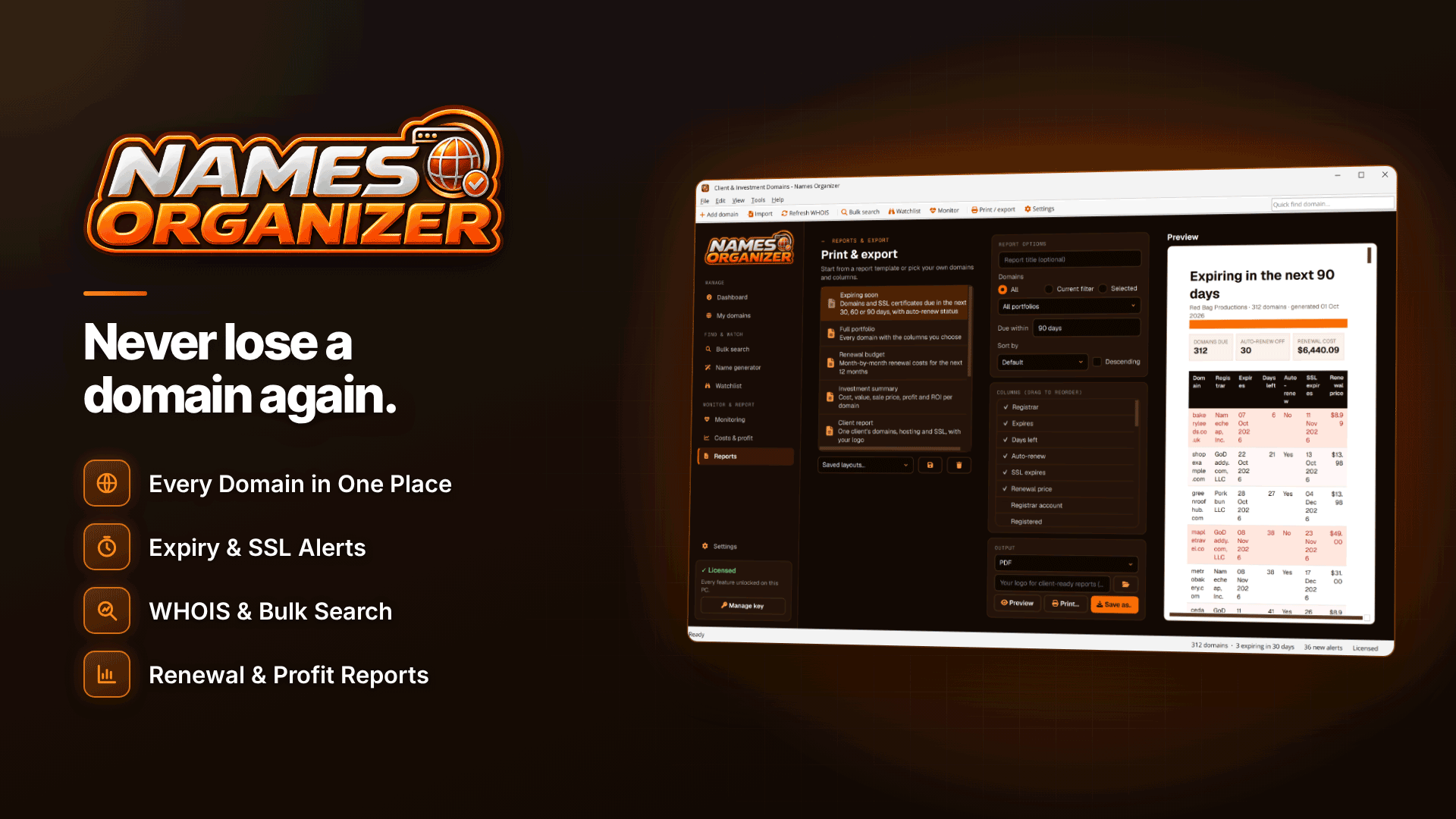
On Windows, Names Organizer includes a bulk availability checker that works across any extension and shows the owner and expiry date for names that are taken, using RDAP lookups with WHOIS fallback. Available names can be opened at your registrar from the results; the app itself doesn't register anything. Results can be exported as an Availability results report in PDF, Word, Excel, CSV or HTML, which is handy if you need sign-off from a partner before buying.
Its name generator helps when the obvious name is gone. It builds variants from prefixes, suffixes, locations, word lists, hyphens, plurals and typo variants, so you can try combinations such as brand plus city or brand plus a country word across several extensions in one run.
Why some results show "Unknown"
Not every European registry offers public RDAP or WHOIS access, and some limit how many lookups you can make. When a ccTLD can't be queried, the result shows as Unknown rather than guessing. Treat Unknown as "check manually": search that name on the registry's own site or at a registrar. Registries also restrict what they publish; DENIC, for example, doesn't show holder details publicly for private individuals.
A worked example
Take a hypothetical affiliate brand, "examplebrand", planning German, French and Dutch versions. A first batch might check examplebrand on .de, .fr, .nl, .be, .at, .ch, .eu and .com. Suppose the results show .de and .nl available, .fr taken by an unrelated company with an expiry date next spring, and .ch returned as Unknown. The plan then writes itself:
- Register the .de and .nl names now, confirming eligibility for each.
- Check .ch by hand on the registry or at a registrar.
- Add the .fr name to the watchlist and, in the meantime, plan French content in a subfolder of the .com.
- Run the generator for fallbacks such as examplebrand-fr or a French-language variant, in case the .fr owner renews.
Whatever you decide, record every new name in one place with its expiry date, because a cluster of country domains bought on the same day will all fall due on the same day too.
Defensive registrations and typo variants
Once your brand earns money in a market, lookalike domains become a risk: typo-squatters harvesting your type-in traffic, or copycats confusing your visitors. You don't need every variant, but consider:
- The brand on the ccTLD of each market you actively serve.
- The most common one-letter typos and the hyphenated version of a two-word brand.
- Local-language spellings if your brand contains a translatable word.
Generated typo variants are useful for spotting what is already registered by others. If someone is using a confusingly similar name to mislead visitors, that is a matter for the registry's dispute procedure or a lawyer, not for guesswork.
How do I get notified when a domain becomes available?
If the name you want is taken but not in use, add it to a watchlist. The Names Organizer watchlist re-checks names every 12 hours by default and alerts you when a name becomes available or enters redemption, pending delete or drops. Checks are scheduled rather than continuous, so for highly contested names you may still lose out to specialist drop-catching services.
Two things to know about expiring domain names in Europe: many ccTLDs don't follow the gTLD lifecycle of redemption and pending delete, and some don't publish expiry dates at all. Read each registry's deletion policy for the names you are watching.
Frequently asked questions
Should I register every European ccTLD for my brand?
Usually not. Register the countries you serve or plan to serve within a year, plus .eu or .com as a hub. Every extra domain is another renewal to track.
Can a UK company register .eu domains?
Not in its own name unless it meets EURid's criteria, which require residence or establishment in the EU or EEA, or EU citizenship for individuals. Check current rules with the registry.
Is "available" in a bulk check guaranteed?
No. It reflects the registry's answer at that moment. Premium, reserved or restricted names can still fail at checkout, so confirm at the registrar before planning around a name.
Next steps
Domain choice is one item on a longer list; work through our European market entry checklist and decide which European language to add first. For naming principles that apply in any market, see how to choose a domain name for an affiliate site, and explore more regional guides in European Markets.
When you have your shortlist of names and countries, run them through Names Organizer in one batch, register the ones you can, and watchlist the ones you can't.


